Best Slotting Machine Manufacturers in India: A Complete Buyer’s Guide
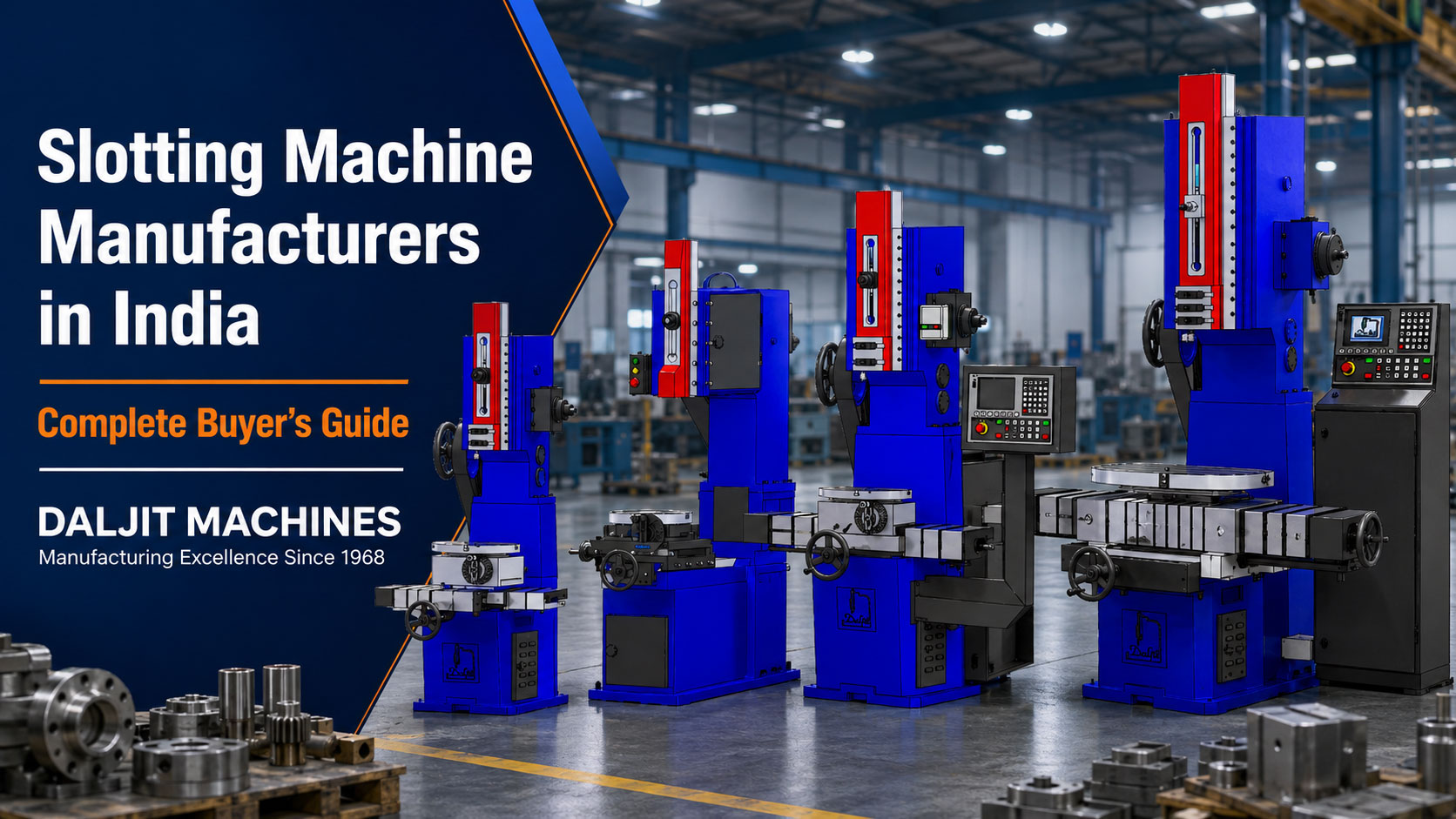
India has a strong and rapidly developing machine-tool industry that supports automotive production, engineering workshops, repair facilities, infrastructure projects and general manufacturing. Among the machines used for precision metalworking, the slotting machine continues to play an important role because of its ability to produce internal keyways, grooves, slots, splines and special internal profiles.
Choosing the right machine is not simply a matter of comparing prices. Buyers must consider the machine type, job dimensions, stroke length, table capacity, motor power, production volume, required accuracy, automation level, tooling, service support and long-term operating costs.
Daljit Machines has manufactured industrial machinery since 1968 and specializes in different types of slotting machines for Indian and international customers. This guide explains the essential factors buyers should evaluate when comparing slotting machine manufacturers in India.
What Is a Slotting Machine?
A slotting machine is a reciprocating machine tool used to remove material from a stationary workpiece. Its cutting tool is attached to a ram that generally moves vertically up and down. The tool removes material during the cutting stroke and returns without cutting during the return stroke.
Because of this vertical reciprocating motion, a slotting machine is sometimes described as a vertical shaper. However, its design and applications make it especially suitable for internal machining operations that may be difficult to perform on conventional shaping or milling machines.
The workpiece is securely mounted on the machine table, and the cutting tool gradually removes material until the required size and profile are achieved.
What Is a Slotting Machine Used For?
Slotting machines are used in tool rooms, repair workshops, machinery manufacturing facilities and industrial production units. Their ability to perform internal machining makes them valuable for producing or repairing specialized components.
Common applications include:
- Cutting internal keyways
- Producing internal and external slots
- Machining grooves
- Cutting internal splines
- Producing square and rectangular holes
- Machining internal gear profiles
- Cutting flat and angular surfaces
- Producing special internal shapes
- Repairing worn machine components
- Manufacturing dies, fixtures and industrial parts
The actual applications depend on the machine’s capacity, tooling, workpiece material and operator skills.
Different Types of Slotting Machines
Manufacturers produce slotting machines in multiple configurations to meet different workshop and production requirements. Understanding these types helps buyers select suitable equipment.
Conventional Slotting Machines
Conventional slotting machines are manually controlled and are commonly used for repair work, job production and small-batch manufacturing. They are suitable for workshops that handle frequently changing components and require operational flexibility.
Their relatively straightforward design can make them easier to operate and maintain, especially where trained conventional machine operators are available.
Vertical Slotting Machines
A vertical slotting machine uses a vertically reciprocating ram. It is widely used for internal keyways, slots, splines and shaped holes. The rotating or adjustable table allows the workpiece to be positioned for different machining requirements.
Mechanical Slotting Machines
Mechanical slotters use a mechanical drive system to produce the ram’s reciprocating movement. They are known for their straightforward construction and suitability for general workshop operations. The machine’s performance depends on its drive design, rigidity, speed settings, stroke adjustment and maintenance condition.
Hydraulic Slotting Machines
Hydraulic slotting machines use hydraulic power to control ram movement. Depending on their design, they may provide smoother motion, adjustable cutting speeds and better control over the cutting cycle. Hydraulic systems require proper maintenance of oil, seals, pumps and other components. Buyers should compare their production requirements and maintenance capabilities before choosing between mechanical and hydraulic models.
Heavy-Duty Slotting Machines
Heavy-duty slotters are designed for larger workpieces and demanding machining operations. They generally feature stronger construction, higher table capacity, powerful motors and longer ram strokes. These machines may be suitable for industrial manufacturers handling large components, deeper slots or challenging materials.
Precision Slotting Machines
Precision slotting machines focus on dimensional accuracy, smooth operation and repeatability. Their effectiveness depends on machine construction, alignment, tooling, job setting and operator expertise. They may be used in tool rooms and production units where accurate internal profiles and keyways are required.
PLC-Controlled Slotting Machines
PLC-controlled machines introduce programmable functions that can reduce manual intervention and improve operating consistency. Depending on the model, controls may help manage stroke, feed, table movement or production cycles. These machines can provide a practical balance between conventional operation and complete CNC automation.
CNC Slotting Machines
CNC slotting machines use computer numerical control to manage machining movements according to programmed instructions. They can be suitable for repeat production, complex profiles and applications requiring greater consistency.
Their potential benefits include:
- Programmable operations
- Improved repeatability
- Better production consistency
- Reduced operator dependence
- Accurate feed control
- Suitability for complex profiles
- Faster processing of repeat jobs
- Improved productivity
A CNC machine usually requires a higher initial investment, suitable programming knowledge, trained operators and dependable technical support.
Mechanical vs Hydraulic Slotting Machines
The primary difference between mechanical and hydraulic slotting machines is the method used to move the ram. A mechanical machine uses gears, cranks or related mechanical components. It may be easier to understand and maintain for workshops already experienced with conventional machine tools. A hydraulic machine uses pressurized oil to control ram movement. Depending on the design, it may offer smoother motion and greater flexibility in controlling speed.
When comparing the two, consider:
- Required stroke control
- Cutting speed
- Maintenance knowledge
- Spare-parts availability
- Operating environment
- Production volume
- Machine price
- Energy consumption
- Required surface quality
Neither design is automatically suitable for every user. The correct choice depends on the intended machining work.
Manual vs CNC Slotting Machines
Manual and CNC machines serve different production requirements.
- A conventional machine may be suitable for:
- Repair and maintenance work
- Simple keyways and slots
- Frequently changing jobs
- Low-volume production
- Limited investment budgets
- Workshops with experienced machinists
A CNC machine may be suitable for:
- Repetitive production
- Complex components
- Close dimensional requirements
- Higher production volumes
- Reduced manual intervention
- Businesses planning greater automation
CNC technology can improve repeatability, but it also introduces additional costs for controls, programming, training and maintenance. Buyers should select automation according to actual production demand instead of choosing the most advanced machine by default.
Technical Specifications to Check Before Buying
Technical specifications determine whether a machine can accommodate the intended workpiece and machining operation.
Important specifications include:
Maximum Ram Stroke
Ram stroke determines the maximum vertical cutting travel. It should be selected according to the height and depth of the required machining operation.
Strokes per Minute
The machine’s stroke range affects cutting speed and suitability for different materials. Harder materials may require different settings from softer metals.
Table Diameter and Movement
The table must provide sufficient space and movement for securely mounting and positioning the workpiece.
Maximum Job Height
The available distance between the cutting tool and table determines the maximum workpiece height the machine can accommodate.
Table Load Capacity
Heavy components require a table and supporting structure capable of handling their weight safely.
Motor Power
Motor capacity should be appropriate for the machine size, workpiece material and expected cutting load.
Tool-Head Adjustment
An adjustable tool head can help produce angular surfaces and specialized profiles.
Machine Weight and Construction
A rigid and adequately weighted machine can help reduce vibration and improve cutting stability.
Floor-Space Requirement
Buyers should consider the machine dimensions and additional space required for the operator, material handling and maintenance access.
Electrical Requirements
Confirm the required voltage, phase, connected load, earthing and electrical protection before installation.
Choosing a Machine for Different Materials
Slotting machines may be used on mild steel, cast iron, stainless steel, aluminium, brass and alloy materials. However, each material behaves differently during machining.
When choosing a machine, consider:
- Material hardness
- Required cutting force
- Tool material
- Cutting speed
- Feed rate
- Slot depth
- Coolant or lubrication
- Required surface finish
- Production quantity
Harder materials may require stronger machine construction, suitable tooling, slower cutting speeds and greater motor capacity. Buyers should provide material and application details when requesting a machine recommendation.
Slotting Machines for Small Workshops
Small workshops need equipment that offers useful capacity without creating excessive investment or operating costs.
Important considerations include:
- Available floor space
- Electricity supply
- Maximum job dimensions
- Expected daily workload
- Operator experience
- Required accuracy
- Tooling availability
- Maintenance capacity
- Investment budget
- Future business plans
A compact conventional machine may be suitable for basic repair and job work. A small PLC or CNC model may be appropriate where repeat production and automation are important. A benchtop or compact machine should only be selected after confirming that it has sufficient rigidity, stroke and table capacity for the intended applications.
Heavy-Duty Slotting Machines for Industrial Work
Heavy-duty machines are intended for larger components and demanding machining operations. Buyers should evaluate the machine structure rather than relying only on its motor rating.
A heavy-duty machine should offer:
- Strong bed and column construction
- Rigid ram assembly
- Adequate motor power
- Suitable table load capacity
- Reliable clamping
- Smooth ram movement
- Appropriate stroke range
- Stable operation under load
- Accessible lubrication points
- Suitable safety guards
Manufacturers should be given complete job information before recommending a heavy-duty model.
Tooling Used for Slotting Operations
Correct tooling is essential for achieving accurate slots, keyways and internal profiles.
Common tooling and accessories include:
- High-speed steel cutting tools
- Carbide-tipped tools
- Keyway-cutting tools
- Internal slotting tools
- Tool holders
- Machine vices
- Clamping fixtures
- Rotary tables
- Dividing attachments
- Digital readout systems
- Measuring instruments
- Lubrication equipment
Tool geometry should be selected according to the material, slot dimensions, cutting direction and required finish. Incorrect tooling can cause vibration, poor finish, inaccurate dimensions and premature tool failure.
How to Cut an Internal Keyway
Internal keyway cutting is one of the most common slotting machine applications.
The general process involves:
- Inspecting the component drawing and keyway dimensions.
- Selecting a suitable cutting tool.
- Mounting the workpiece securely on the table.
- Aligning the bore with the tool.
- Setting the appropriate ram stroke.
- Selecting a suitable cutting speed and feed.
- Taking gradual cuts to remove material.
- Measuring the keyway regularly.
- Continuing until the specified width and depth are achieved.
- Inspecting the final dimensions and surface finish.
The exact procedure depends on the workpiece, material, machine and tolerance. Only trained operators should perform slotting operations.
Power Consumption of a Slotting Machine
Power consumption depends on the motor rating, machine capacity, cutting load, material and daily operating hours.
When evaluating energy requirements, check:
- Main motor rating
- Hydraulic power-pack consumption, if applicable
- CNC or PLC control requirements
- Coolant and lubrication systems
- Starting current
- Average operating hours
- Local electricity costs
The machine should be correctly sized for the workload. An unnecessarily large machine may consume more power and occupy additional factory space.
Essential Safety Features
Safety should be evaluated before purchasing and operating any machine tool.
Important features include:
- Emergency stop control
- Electrical overload protection
- Proper earthing
- Guards for moving components
- Secure tool holding
- Reliable workpiece clamping
- Table-locking arrangements
- Accessible operating controls
- Clearly marked switches
- Lubrication indicators
- Operating and safety instructions
Operators should receive proper training and wear suitable personal protective equipment. Machines should never be operated with damaged guards or unsecured workpieces.
Installation and Setup
Proper installation helps a slotting machine achieve stable and accurate performance.
The process may include:
- Preparing a suitable foundation
- Positioning and levelling the machine
- Completing electrical connections
- Checking earthing
- Filling or checking lubricants
- Inspecting mechanical alignment
- Running the machine without load
- Conducting a trial machining operation
- Training the operator
- Reviewing maintenance procedures
Installation requirements should be discussed with the manufacturer before delivery.
Slotting Machine Maintenance
Preventive maintenance helps reduce breakdowns and preserve accuracy.
Recommended practices include:
- Cleaning chips after every shift
- Lubricating specified points
- Checking oil levels
- Inspecting cutting tools
- Tightening loose fasteners
- Monitoring unusual noise
- Checking drive components
- Inspecting electrical connections
- Maintaining table and ram alignment
- Replacing worn components
- Following the manufacturer’s maintenance schedule
Maintenance records can help identify recurring problems and plan future servicing.
Troubleshooting Common Problems
Excessive Vibration
Possible causes include loose clamping, worn tools, excessive cutting depth, unsuitable speed or machine alignment problems.
Poor Surface Finish
This may result from blunt tools, incorrect feed, excessive vibration, improper tool geometry or loose workholding.
Inaccurate Slots
Check workpiece alignment, tool position, table movement, tool wear and machine condition.
Unusual Noise
Unusual sound may indicate insufficient lubrication, worn gears, loose components or excessive load.
Motor Overheating
Possible causes include overloading, voltage problems, blocked ventilation or electrical faults.
Operators should stop the machine and seek qualified technical assistance if a fault cannot be safely identified.
Spare Parts and After-Sales Support
A machine’s long-term value depends partly on the availability of spare parts and service support.
Before purchasing, ask:
- Which spare parts are normally available?
- What does the warranty cover?
- Is installation assistance provided?
- Is operator training available?
- How are service requests handled?
- Are manuals and diagrams supplied?
- Are preventive maintenance contracts available?
- Can remote troubleshooting be provided?
Specific service availability should always be confirmed with the manufacturer for the buyer’s location.
Customized Slotting Machines
Standard machines may not suit every industrial application. Some buyers may require customized stroke length, table dimensions, motor capacity, controls, tooling or automation.
To request customization, provide:
- Component drawing
- Workpiece material
- Maximum dimensions
- Required slot or profile
- Tolerance
- Production quantity
- Preferred automation level
- Electrical supply
- Required accessories
- Delivery destination
The manufacturer can then evaluate technical feasibility and recommend a suitable configuration.
Exporting Slotting Machines from India
Indian manufacturers supply machine tools to buyers in many international markets. Overseas customers should confirm:
- Machine specifications
- Required voltage and frequency
- Export packaging
- Documentation
- Inspection requirements
- Installation support
- Spare-parts supply
- Operator manuals
- Shipping terms
- Destination port
Strong export packaging is important for protecting equipment from moisture, vibration and handling damage during transportation.
Why Choose Daljit Machines?
Daljit Machines is an established Indian manufacturer and exporter of slotting machines. The company has served the machine-tool industry since 1968 and exports its products to more than 52 countries. Its slotting machine range includes conventional, precision, heavy-duty, PLC-controlled and CNC models designed for different workshop and industrial requirements.
Reasons buyers can consider Daljit Machines include:
- Manufacturing experience since 1968
- Specialization in slotting machines
- Machines for different job sizes
- Conventional and automated options
- Heavy-duty industrial models
- Export experience across 52+ countries
- Technical guidance during selection
- Focus on machine quality and performance
- Solutions for Indian and international buyers
Customers should share their complete application details to receive an appropriate machine recommendation.
Request a Slotting Machine Quotation
For an accurate quotation, provide:
- Required machine type
- Workpiece dimensions
- Material to be machined
- Required stroke length
- Slot dimensions
- Expected production quantity
- Required accuracy
- Preferred automation level
- Power supply
- Accessories
- Delivery city and country
Complete information allows the manufacturer to recommend an appropriately sized machine and prepare a relevant commercial offer.
Frequently Asked Questions
What is the primary use of a slotting machine?
A slotting machine is mainly used for internal keyways, slots, grooves, splines, shaped holes and special internal profiles.
Which slotting machine is suitable for a small workshop?
The correct machine depends on the maximum workpiece size, required stroke, production volume, power supply, available space and budget.
What is the difference between a conventional and CNC slotting machine?
A conventional machine relies more heavily on manual operation, while a CNC machine uses programmed controls to manage machining movements and repeat operations.
How much does a slotting machine cost in India?
The cost depends on machine capacity, stroke, table size, motor power, automation, accessories, installation and customization.
Can slotting machines cut stainless steel?
A suitable machine can work with stainless steel when it has adequate rigidity, power, appropriate tooling and correctly selected cutting parameters.
Can a slotting machine cut internal keyways?
Yes. Internal keyway cutting is one of the machine’s most common applications.
Are heavy-duty slotting machines available?
Yes. Heavy-duty models are available for larger components, longer strokes and demanding industrial operations.
Are customized slotting machines available?
Customization may be possible depending on the required stroke, table size, motor capacity, controls and production application.
How often should a slotting machine be maintained?
Daily cleaning and routine lubrication should be combined with scheduled inspections according to the manufacturer’s recommendations and operating conditions.
What safety features should buyers check?
Buyers should check emergency stops, electrical protection, safety guards, secure clamping, accessible controls and proper operating documentation.
Can Indian slotting machines be exported?
Yes. Daljit Machines exports slotting machines to customers across more than 52 countries.
Conclusion
Choosing among slotting machine manufacturers in India requires careful consideration of machine capacity, construction, accuracy, tooling, automation, safety and after-sales support. Buyers should not select a machine based only on its price. The equipment must be suitable for the actual job dimensions, material, workload and production goals.
Daljit Machines combines more than five decades of manufacturing experience with a specialized range of conventional, heavy-duty, PLC and CNC slotting machines. Businesses looking for dependable slotting solutions can contact Daljit Machines with their technical requirements to receive guidance and a customized quotation.