
What Are the Key Factors to Consider When Choosing Machining Equipment for a Small Manufacturing Unit in India?
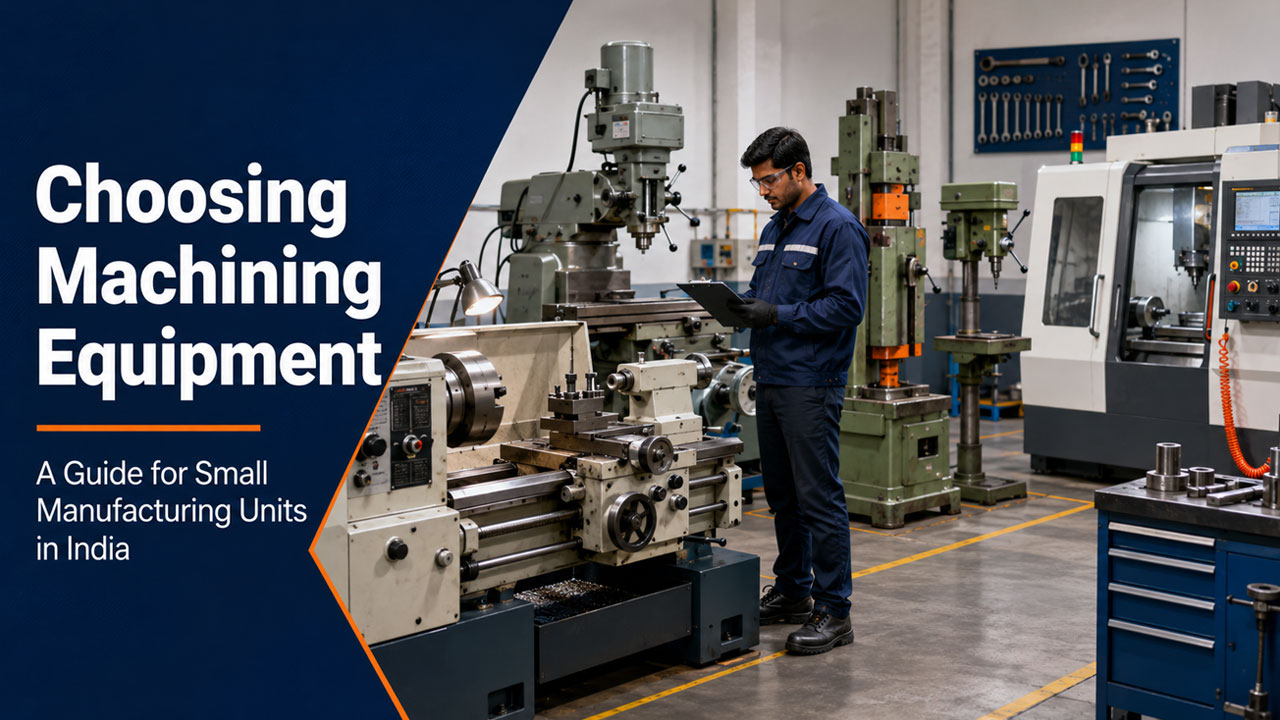
Setting up or expanding a small manufacturing unit requires careful investment decisions. Machining equipment often represents one of the largest expenses for a business, and selecting the wrong machine can affect production quality, operating costs, delivery schedules and profitability.
Small manufacturers in India have access to conventional, semi-automatic, CNC and PLC-controlled machines. However, the most advanced or expensive machine is not necessarily the best option for every workshop. The right choice depends on the products being manufactured, expected production volume, available workforce, power supply, factory space and long-term business plans.
This guide explains the key factors small manufacturing units should consider when selecting machining equipment in India.
Understand Your Manufacturing Requirements
The first step is to clearly define what the machine will be expected to produce. A machine suitable for repair work and small batches may not be appropriate for continuous mass production.
Before contacting a machinery manufacturer or supplier, determine:
- The type of components to be produced
- Raw materials to be machined
- Maximum workpiece dimensions
- Required accuracy and tolerance
- Expected production volume
- Number of working hours per day
- Surface-finish requirements
- Type of machining operations
- Possibility of future production expansion
These details help manufacturers recommend equipment with the correct capacity, power, speed and configuration.
Identify the Required Machining Operations
Different machines perform different manufacturing operations. Small businesses should identify the exact processes required instead of purchasing machines based only on popularity.
Common machining equipment includes:
Lathe Machines
Lathe machines are used for turning, facing, threading, drilling and shaping cylindrical components. They are widely used in engineering workshops, repair units and component manufacturing facilities. (View Lathe Machine Products)
Milling Machines
Milling machines are used for producing flat surfaces, slots, profiles, gears and other complex shapes. They can handle a wide range of industrial machining operations. (View Milling Machine Products)
Slotting Machines
Slotting machines are commonly used for producing internal keyways, slots, grooves, splines and internal profiles. They are particularly useful when internal shapes are difficult to produce with other conventional machines. (View Slotting Machine Products)
Drilling Machines
Drilling machines are used to produce holes in metal and other materials. Depending on the application, a business may require a bench, pillar, radial or heavy-duty drilling machine. (View Drilling Machine Products)
Shaping Machines
Shaping machines are used to machine flat, angular and contoured surfaces. They remain useful for tool rooms, maintenance departments and low-volume production work. (View Shaper Machine Products)
Grinding Machines
Grinding machines provide accurate dimensions and improved surface finishes. They are used when components require close tolerances or smooth surfaces. (View Grinding Machine Products)
Bandsaw and Hacksaw Machines
These machines are used for cutting raw materials into the required lengths before further machining operations. (View Bandsaw Machine and Hacksaw Machine Products)
Choose Between Conventional and CNC Machines
One of the most important decisions is whether to purchase conventional machinery or CNC equipment.
Conventional Machines
Conventional machines are operated manually and generally have a lower initial purchase cost. They can be suitable for:
- Repair and maintenance work
- Job shops
- Tool rooms
- Low-volume production
- Simple components
- Frequently changing jobs
- Units with experienced machine operators
They are generally easier and less expensive to maintain, but product quality and output may depend heavily on the operator’s skill.
CNC Machines
CNC machines use programmed controls to perform machining operations. They may be suitable for:
- High-volume production
- Components requiring close tolerances
- Complex geometries
- Repetitive machining
- Reduced operator dependence
- Consistent product quality
- Businesses planning production expansion
CNC equipment usually requires a higher initial investment, trained programmers, suitable tooling and dependable technical support.
Semi-Automatic and PLC-Controlled Machines
For some manufacturers, semi-automatic or PLC-controlled machinery can provide a practical balance between conventional and CNC equipment. These machines may increase productivity and consistency without requiring the investment associated with fully automated equipment. The correct level of automation should be selected according to production needs rather than market trends.
Evaluate the Machine’s Capacity
Every machine has operating limits. Purchasing equipment with insufficient capacity can restrict production, while buying an oversized machine may unnecessarily increase costs, electricity consumption and floor-space requirements.
Important capacity specifications include:
- Maximum workpiece size
- Table diameter or bed length
- Ram stroke
- Spindle speed range
- Motor power
- Cutting capacity
- Load-bearing capacity
- Tool travel
- Maximum machining diameter
- Feed range
It is sensible to choose a machine that can handle present requirements with some additional capacity for future work. However, excessive unused capacity may not provide a good return on investment.
Check Accuracy and Repeatability
Accuracy refers to how closely a machine can produce the required measurement. Repeatability refers to its ability to produce the same result consistently over multiple cycles.
These factors are particularly important for components used in:
- Automotive assemblies
- Industrial machinery
- Tool rooms
- Dies and moulds
- Precision engineering
- Aerospace-related supply chains
- Hydraulic equipment
- Gear and transmission systems
Buyers should discuss required tolerances with the machine manufacturer and, where possible, request a machining demonstration or sample component. A small workshop producing general repair components may not require the same precision level as a company supplying critical parts to an OEM. Paying for unnecessary precision can increase investment without providing additional business value.
Consider the Materials to Be Machined
Machine requirements vary according to the material being processed. Mild steel, stainless steel, aluminium, brass, cast iron and hardened materials have different machining characteristics. The machine should have sufficient rigidity, torque, spindle power and speed range for the intended material. Tooling and coolant requirements may also change according to the material.
Before purchasing equipment, inform the supplier about:
- Material type
- Material hardness
- Typical component size
- Cutting depth
- Required production speed
- Surface-finish expectations
This information helps determine whether the machine can perform reliably under actual operating conditions.
Calculate the Total Cost of Ownership
The purchase price is only one part of the machine’s total cost. A low-priced machine may become expensive if it requires frequent repairs, consumes excessive power or causes production delays.
The total cost of ownership may include:
- Machine purchase price
- GST and other applicable charges
- Transportation
- Loading and unloading
- Installation
- Foundation work
- Electrical connections
- Tooling and accessories
- Operator training
- Electricity consumption
- Lubricants and coolant
- Routine maintenance
- Replacement parts
- Software and programming
- Production downtime
- Future repairs
Businesses should compare machines based on long-term value and not solely on their initial prices.
Examine Build Quality and Machine Rigidity
Machine rigidity directly affects cutting stability, accuracy, vibration and product finish. Equipment with a strong body and properly designed structure can generally handle machining loads more effectively.
When inspecting a machine, check:
- Quality of casting and fabrication
- Machine weight
- Bed and column construction
- Guideways
- Spindle assembly
- Table stability
- Gearbox quality
- Alignment
- Electrical components
- Lubrication system
- Safety guards
A well-built machine may provide more dependable performance and a longer operating life.
Consider Power Availability and Consumption
Electricity supply varies between industrial areas in India. Before selecting a machine, verify that the manufacturing unit has the required electrical connection and load capacity.
Check:
- Single-phase or three-phase requirement
- Motor rating
- Voltage requirement
- Starting load
- Total connected load
- Power consumption during operation
- Requirement for a voltage stabilizer
- Backup power compatibility
- Earthing requirements
Energy-efficient equipment can help control operating expenses, especially when machines run for several hours each day.
Measure the Available Factory Space
Machine dimensions alone do not represent the total space required. Additional room is needed for operators, electrical panels, raw materials, finished products, maintenance and safe movement.
Before placing an order, prepare a basic factory layout covering:
- Machine dimensions
- Operator working area
- Material loading space
- Tool storage
- Electrical connections
- Maintenance access
- Ventilation
- Coolant and waste handling
- Safe movement paths
Also verify whether doors, passages and loading areas are large enough to move the equipment into the workshop.
Check Tooling and Accessory Availability
A machine cannot deliver the required results without suitable tools and accessories. Buyers should confirm which accessories are included in the quoted price and which need to be purchased separately.
Depending on the machine, additional requirements may include:
- Cutting tools
- Tool holders
- Chucks
- Vices
- Clamping equipment
- Arbours
- Mandrels
- Collets
- Coolant systems
- Lubrication equipment
- Digital readout systems
- Rotary tables
- Dividing heads
- Safety guards
The availability and price of tooling should be included in the investment calculation.
Confirm Spare Parts and After-Sales Support
For a small manufacturing unit, unexpected machine downtime can stop production and delay customer orders. Reliable after-sales service is therefore one of the most important selection factors.
Before purchasing, ask the supplier:
- Are spare parts readily available?
- Is installation support included?
- Is operator training provided?
- How quickly can service engineers respond?
- Is remote technical assistance available?
- What is covered by the warranty?
- Are electrical and mechanical diagrams supplied?
- Does the manufacturer maintain service records?
- Are consumable parts available locally?
A slightly more expensive machine with reliable support may provide better value than a cheaper machine with limited service availability.
Evaluate Operator Skills and Training Requirements
Advanced equipment cannot produce good results without trained operators. Small manufacturers should consider the experience of their existing workforce before selecting machinery. Conventional machines may require experienced machinists, while CNC machines require operators who understand programming, tooling, offsets and machine controls.
Training requirements may include:
- Machine operation
- Job setting
- Tool selection
- Measurement
- Routine maintenance
- Safety procedures
- CNC programming
- Fault identification
If trained workers are unavailable locally, the manufacturer should provide suitable installation and operational training.
Review Production Speed and Productivity
A machine should help the business complete orders within the required timeframe. However, productivity is not determined by cutting speed alone.
Overall productivity can be affected by:
- Job-setting time
- Tool-changing time
- Material handling
- Cutting speed
- Feed rate
- Operator efficiency
- Machine downtime
- Inspection requirements
- Maintenance frequency
For repeat production, automated equipment may reduce cycle times. For frequently changing jobs, a flexible conventional or semi-automatic machine may be more practical.
Look for Flexibility and Future Expansion
A small manufacturing unit may begin with a limited product range but receive different customer requirements as the business grows.
Consider whether the machine can:
- Handle different component sizes
- Perform multiple operations
- Use additional accessories
- Support digital readouts
- Be upgraded with automation
- Accept different tools and fixtures
- Work with multiple materials
- Support future production volumes
Flexible equipment may allow a business to accept a broader range of orders without immediately purchasing another machine.
Verify Safety Features
Industrial machinery can cause serious injuries when it is improperly installed or operated. Safety should never be compromised to reduce costs.
Important safety features may include:
- Emergency stop controls
- Proper electrical protection
- Belt and gear guards
- Chuck or tool guards
- Overload protection
- Limit switches
- Secure clamping systems
- Clear operating instructions
- Suitable lighting
- Safe access for maintenance
Operators should receive safety training and use appropriate personal protective equipment.
Inspect the Machine Before Purchasing
Whenever possible, visit the manufacturer’s facility or arrange a live video demonstration. An inspection allows buyers to assess the machine’s build quality, operation, noise, vibration and finish.
During a demonstration:
- Run the machine at different speeds
- Check movement for smoothness
- Observe vibration and noise
- Inspect the lubrication system
- Review electrical controls
- Machine a sample component
- Measure the finished component
- Check the surface finish
- Discuss maintenance procedures
- Verify included accessories
If purchasing a used machine, professional inspection becomes even more important.
Compare New and Used Machinery
Used machinery may reduce initial investment, but it can also involve greater risk.
Before buying used equipment, examine:
- Machine age
- Operating history
- Maintenance records
- Guideway wear
- Spindle condition
- Gearbox noise
- Electrical condition
- Accuracy
- Availability of spare parts
- Repair requirements
New machinery generally provides warranty protection, updated components, installation support and greater predictability. The final decision should be based on machine condition and total ownership cost.
Review Manufacturer Experience and Reputation
Select a machine manufacturer or supplier with relevant experience in the required equipment category.
Evaluate:
- Years of manufacturing experience
- Product specialization
- Customer feedback
- Domestic installations
- Export experience
- Manufacturing facilities
- Technical knowledge
- Quality-control procedures
- Service capabilities
- Availability of references
Manufacturers specializing in a particular machine category may offer better technical guidance than general equipment traders.
Frequently Asked Questions
Which machining equipment is best for a small manufacturing unit?
The right equipment depends on the products, materials, required operations, tolerances and production volume. There is no single machine suitable for every manufacturing unit.
Should a small manufacturer buy a conventional or CNC machine?
Conventional machines can be suitable for repair work, simple components and low-volume production. CNC machines are generally more appropriate for repetitive production, complex components and close tolerances.
Is used machinery a good choice for a new manufacturing unit?
Used equipment may reduce the initial investment, but it should be inspected for wear, accuracy, electrical condition and spare-parts availability before purchase.
How should machine capacity be selected?
Choose equipment that can handle current requirements with reasonable additional capacity for future growth. Avoid machines that are significantly undersized or unnecessarily oversized.
Why is after-sales service important?
Reliable service and spare-parts availability reduce downtime and help the manufacturing unit maintain production schedules.
What costs should be considered apart from the machine price?
Consider transportation, installation, tooling, electrical work, foundation, training, energy consumption, maintenance, consumables and repairs.
How can a buyer verify machine accuracy?
Request a machining demonstration and measure the finished sample using suitable inspection instruments.
What information should be included in a machinery enquiry?
Include the component drawing, material, dimensions, operations, tolerances, production volume, power availability, automation preference and required accessories.
Conclusion
Choosing machining equipment for a small manufacturing unit in India requires a balance between production requirements, investment capacity and long-term business goals. The right machine should provide adequate capacity, reliable accuracy, reasonable operating costs and dependable technical support.
Before making a purchase, buyers should clearly define their manufacturing needs, compare conventional and automated options, calculate the total cost of ownership and inspect the equipment. They should also confirm tooling, spare parts, training, safety features, warranty and after-sales service.
A carefully selected machine can improve productivity, maintain consistent quality and help a small manufacturing business grow sustainably. A poorly selected machine, however, can remain underutilized or create recurring production and maintenance problems. Taking time to evaluate every technical and commercial factor is therefore essential before making the final investment.